Transcript
Announcer:
Welcome to Clinician's Roundtableon ReachMD, this episode is sponsored by Exact Sciences, now Abbott. And now here’s your host, Dr. Brian McDonough.
Dr. McDonough:
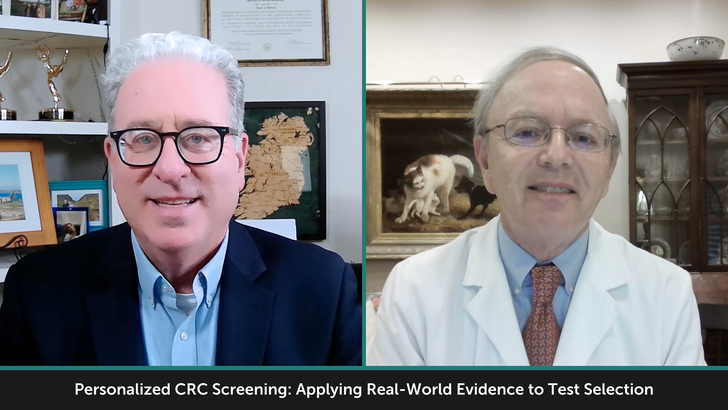
Welcome to Clinician's Roundtable on ReachMD. I'm Dr. Brian McDonough, and joining me to discuss how we can individualize colorectal cancer screening recommendations to improve long-term adherence is Dr. David Johnson. He's a Professor of Medicine and Chief of Gastroenterology at Eastern Virginia Medical School at Old Dominion University.
Dr. Johnson, welcome to the program.
Dr. Johnson:
Glad to be here. I look forward to the conversation with you.
Dr. McDonough:
Well, let's start with some background. Even though colorectal cancer screening rates have improved overall, we're still seeing patients that don't get tested at the recommended interval or complete any recommended follow-up testing. I know as a family doctor, I see that on a regular basis. I try to communicate the information, but often people either don't listen, get lost to follow-up, or just say, "I'm not going to do it."
So with that in mind, Dr. Johnson, I'd like to hear your perspective on recommending testing modalities to patients. For years, discussions about colorectal cancer screening have focused on which type of test offers the greatest benefit, but recent evidence has shown that adherence can also play an important role in long-term outcomes. So how should that change the way we think about recommending a screening modality for a given patient?
Dr. Johnson:
I think it's a great question. Certainly, the current evidence shows a substantial, what I would call, “last-mile problem.” So overall, colorectal cancer screening's improved somewhat, but a large minority of adults are either never screened, screened too late, or failing to complete the next test on an abnormal test.
And there are two recent databases that I'd like to highlight to emphasize that point. One is from the CDC, and that was published in 2023. It showed that approximately 64 percent of adults in the age range of 45 to 75 were up to date after age standardization. The screening for the 45- to 49-year olds with the new screening recommendation was only 37 percent compared to 73 percent. But still, we're way behind where we should be.
And a more recent publication, although it used a 2022 database looking at behavioral risk analysis, was a telephone-based survey that was published in 2025. It showed an especially useful way of looking at your point. So 61 percent of patients were actually up to date. 6 percent had been screened but were overdue, and that's a problem. 32 percent had never been screened, so this translates to approximately 28 million adults 45 to 75 who've never undergone colorectal screening.
But the problem there is it's actually a cascade, and so there are really three different failures. One is never getting the initial test, and that's about one-third of the eligible results, and particularly pronounced even higher in the 45- to 49-year-olds, as I mentioned.
The second is not repeating the test at the recommended interval. So the recommendation, for example, for FIT screening, or fecal immunochemical testing, is on an annualized basis. Well, in studies that have looked at this in systematic reviews, they showed that less than 50 percent of people who had that initial test, if they even had that, came back for a subsequent test. So failure to repeat a test at the recommended interval.
And then perhaps the most clinically important gap, to get to your question, is failure after an abnormal non-invasive test. So, for example, a positive FIT test or other non-colonoscopy test does not complete the screening process; it requires a diagnostic colonoscopy. Now let's look at the data on that and look at FIT test, or stool-based testing, or the multi-target stool DNA test. So for FIT tests, the recommendation from the national guidelines, and I was on the guidelines committees for 17 years, is to do the colonoscopy within 90 days. And if you look at the data on the number that don't have it, for FIT tests, it’s 77 percent who aren’t compliant with the guidelines. If we look at the stool DNA test, the number is better, but still 37 percent. And then if you look at a year—the recommendation, again, is 90 days, but now if we give it a year window—the FIT test is still in the 40 to 65 percent who do not get that recommended test. The stool DNA test is better, somewhere in the range of 15 to 30 percent.
So again, we're really missing the message that colorectal cancer screenings improve, but the population effectiveness is substantially lower than these headline screenings.
Dr. McDonough:
A recent nationwide claims analysis found that participation in colorectal cancer screening varies not only by screening modality, but also by sex, socioeconomic status, and whether patients live in metropolitan or non-metropolitan areas. How should these real-world patterns—along with factors like prior screening behavior, hesitancy, insurance status, and access to care—influence the way we individualize screening recommendations?
Dr. Johnson:
I'm very familiar with that. It was a JAMA study. It was a national claims analysis of nearly 25 million commercially insured individuals, and it illustrates why this matters, because screening patterns differed by, as you point out, gender, socioeconomic status, and geography. Women, for example, use stool-based tests more often. Men use colonoscopy more often. Higher socioeconomic regions—not individuals, but regions—had substantially greater colonoscopy and stool DNA use. Metropolitan residents had greater colonoscopy and FIT tests than non-metropolitan residents.
So the other point there is prior behavior may be more useful than demographics. It's critically important for the primary care provider to understand this. I would use sex, ethnicity, socioeconomic region, and geography as signals to explore barriers but not as reasons to prescribe a particular test just because you have some of those identifiables. Recognize that access to primary care, in your case, is strongly associated with colorectal screening testing, and the odds ratio of a primary care visit is still twice the odds that they're going to get screened as opposed to not screened. Although about 25 percent of the people who had been recommended for screening didn't get that testing, so again, it's a primary care focus.
Ethnicity shouldn't really inform outreach or restrict the choice, and we start to look at things like language, culture, or transportation. Those things also are modifiable potentially. But the current evidence, as you point out, is that disparities in colorectal cancer outcomes are substantially related to these barriers and inequities of access, utilization, or quality of care rather than simple biologic differences between racial groups or regions.
Insurance status is especially important. I will reflect back on one of the most meaningful things I think I've done in my career. In 1998, we wrote the first colorectal cancer screening bill in the country, working with Senator Emily Couric, and required insurance to cover colorectal screening for insured benefits. And this has really set the standard for the rest of the country to now do this. But insurance really drives what's going to happen based on what your recommendations are going to do.
So I would surmise this in a practical framework. I'd look at this and structure the primary care conversation with around 5 questions. First, what's the risk for that individual? So are they a patient of age, family history, and other risk factors? Smoking may be one of those in particular. Is it patient preference? What's their behavior? And again, this develops into almost what I would call a pedigree of what they've done previously. Access is the other part; can they do the test, whatever you recommend? And then more importantly, if they take a non-invasive test, can they get access to a colonoscopy? And a critical one, in particular for primary care, is the follow-through. So which strategy is the most likely to be completed over the entire screening pathway over time?
So I wouldn't ask which test is the best, but which evidence-based screening strategy this patient is most likely to complete with successful completion of the entire pathway if that test is abnormal.
Dr. McDonough:
For those just joining us, this is Clinician's Roundtable on ReachMD. I'm Dr. Brian McDonough, and I'm speaking with Dr. David Johnson about how we can individualize colorectal cancer screening recommendations.
In my own practice, I've noticed that colonoscopy and stool-based screening seem to have opposite implementation challenges. With colonoscopy, the biggest hurdle is often getting patients to agree to the procedure in the first place, but once they receive a negative result, they're covered for 10 years. On the other hand, patients may be more willing to do stool-based screening, but they don't always follow through. And if they do complete stool-based testing and receive an abnormal result, they don't always complete a follow-up colonoscopy. So, Dr. Johnson, how do those real-world patterns influence your recommendation for an individual patient?
Dr. Johnson:
I think that test performance is only one component of effectiveness. So what we're talking about is test performance completion, repeat at the appropriate interval, and a positive test follow-up with diagnostic colonoscopy. And if any link is broken in that, the sensitivity test really doesn't transfer into what we're really trying to do with screening, which is cancer prevention. The patient's behavior becomes part of this effectiveness.
And let me give you an example of how you start to look at these tests. There are two blood tests now that have been available since 2025, and both are almost exactly similar. But when you start to talk about options and talk to patients about non-invasive versus invasive colonoscopy, it's critical to put some guidelines and guardrails around that.
And the article that just was published in August in JAMA puts a highlight on this. So with the two blood tests, which may seem very convenient for the patient, they say, "Sure, I'll do that, because I'm going to get blood tests anyway." You need to explain to the patient a couple things. One is the advanced precancerous lesions, and by that, I mean that they have a high-risk histology, villous histology, high-grade dysplasia, or a large size of 10 millimeters or greater, are very high risk for progression one step below colon cancer. Approximately 90 percent of the patients with those criteria are missed by the serum blood test. Now, if you talk about early colon cancer, it’s still a relatively curable disease at stage I, and maybe less but still curable at stage II. For stage I cancer, between these two, it's approximately the same as it relates to miss rate. Approximately a 39 to 40 percent miss rate in the two studies. And in one of the studies, they actually looked at the size of the cancer. So for cancer that was smaller than 10 millimeters, zero were detected as it relates to these serum tests.
So you've got to put guardrails. It means that we missed 20 percent, or that 1 out of 5 who have cancer are missed.
Dr. McDonough:
Survey research suggests that patients weigh factors like cost, convenience, bowel preparation, invasiveness, and accuracy differently, but provider recommendation consistently remains one of the strongest influences on screening decisions. Given that importance, how can we structure conversations so that patients feel informed and empowered to choose the screening pathway that's the best fit for them?
Dr. Johnson:
Patients come to you because they trust you. And the way that I would phrase this is the power of what you recommend is important. So let me give you some examples of what I would suggest if you're going to lead this discussion with a patient. You need to talk about what a patient really expects, and what they are really likely to accept. You'd start to say, "Well, here is my recommendation." You have the menu but the power of you as the provider, the advanced provider or the physician provider, is immeasurably strong, and this we know drives a lot. Menus are confusing when they get beyond two or three choices. So you give them the menu, and without appropriate direction, it really becomes very confusing and really not something that the patients would benefit from. So that's of critical importance.
Then you start to talk about, "Well, what would you like to accept or what would you be willing to accept? Would you accept my first recommendation? If not, let's talk about barriers and why you wouldn't want to do a colonoscopy." And maybe talk through, “I've had a colonoscopy. I can tell you the prep has changed. Lots of patient satisfaction scores have changed.” The willingness to repeat is there, and you get to a ten-year interval versus recommendations for the serum test, which I told you misses one out of five, and that's a three-year interval. So you're talking about patients with cancer now that potentially goes for three years. Or a FIT test, which is one year. Or a stool DNA test, which is three years. So the reproduction of this as it goes forward will really be important.
And then what would the patient's previous behavior tell you about what they're willing to do? And are there also access or issues as we talked about—socioeconomics and convenience, those things—what can we do to mitigate those? And if there's hesitancy, let's talk about it. Again, in primary care, you only have a certain number of minutes, so you can't really go into very detail. But there are lots of key concepts around individualizing for that person the modality of choice, the importance of completion, and repeat adherence. Positive test follow-up is critically important, and that should be colonoscopy, and that should be laid out very clearly going forward.
Dr. McDonough:
With those strategies in mind, I want to thank my guest, Dr. David Johnson, for joining me to share his perspective on colorectal cancer screening recommendations in real-world care. Dr. Johnson, it was great having you on the program.
Dr. Johnson:
My privilege to be with you.
Announcer:
This episode of Clinician's Roundtable was sponsored by Exact Sciences, now Abbott. To access this and other episodes in this series, visit Clinician's Roundtable on ReachMD.com, where you can Be Part of the Knowledge. Thanks for listening!